Wednesday, January 10, 2024

Santa Fe bright skies - another sparkle filter test

The sky was "clear" last night, a brief interlude between snow storms.  I could see stars, and no obvious clouds, but I wouldn't call it "dark".  The measured sky brightness was sqml=18.74.  This is about 14 times brighter than a nice dark sky (21.6) in Creede.

I wanted to try out the Hoya Sparkle 6x filter with a shorter focal-length lens, so I set up the Sony A7iii with a Samyang 24mm f/1.8 AF lens.  This lens has a convenient feature for astrophotography.  There is a button on the lens body that sets the focus to infinity if it is pressed while turning the camera on.  This saves time from having to mess around with getting the focus correct.

The image below was obtained using ISO1600 at 15 sec.  This was too much exposure for the sky brightness.  ISO800 would have been better.  A big adjustment to the black level was required to make it look like night.  According to Alyn Wallace the Sony A7iii is ISO invariant above ISO640, so that would be an even better setting.

I like the effect of this filter.  It will be interesting to do a comparison with the Hoya/Kenko Softon filter under truly dark skies.  

Sony A7iii + Samyang 24mm f/1.8 AF.  2x binning.

Sirius (Alpha Canis Majoris) and Murzim (Beta Canis Majoris).  12.5° field.

Orion.  22° field.

As usual, click on an image to get access to the full-size version.

Tuesday, January 2, 2024

More sparkle

The sky was clear, so I was able to get a couple more test images with the Hoya Sparkle 6x filter. Both were obtained with an Olympus E-M5iii camera and Sigma 30mm f/1.4 lens: 15-sec exposures (on a tracking mount) at ISO 1600.   Downtown Santa Fe is not the ideal location for doing wide-angle astrophotography.  The sky brightness measured after taking these two shots was sqml=19.42, more than six times brighter than a mediocre dark sky in Creede.  You can see the murk of city lights in the lower part of the Orion image. On the other hand, the temperature in Creede was 6° F and falling vs 31° F here.

Orion 

The Hyades and the Pleiades.


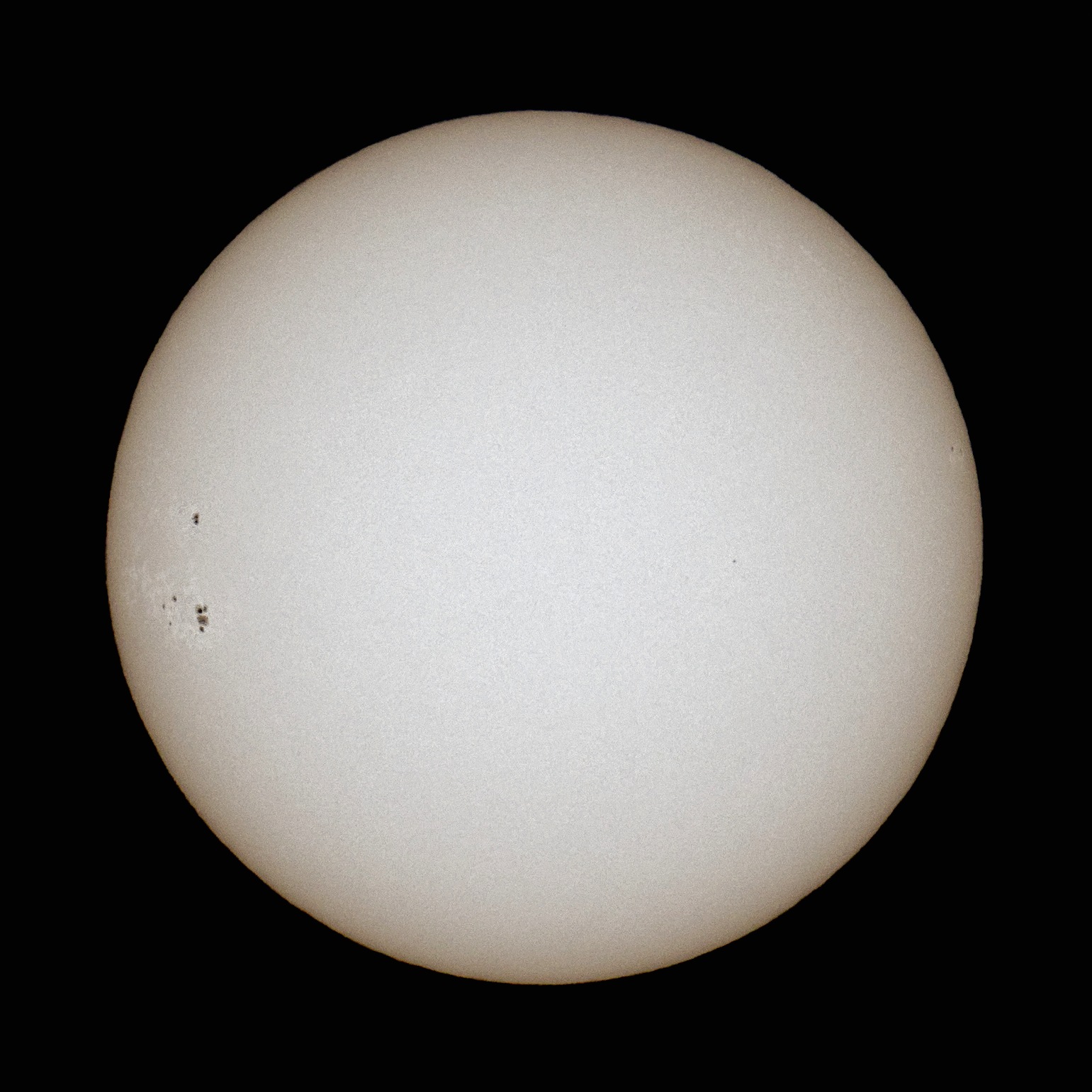
Perihelion 2024

 Today the earth is at perihelion, the closest it gets to the sun during its yearly orbit.  The apparent solar diameter of 0.542° is 1.7% larger than average.

E-M1iii + AT72EDII + Lunt solar wedge + ND-0.9 filter.  ISO 200, 1/800 s.


Monday, January 1, 2024

A New Year and a new filter

 To my eye, wide-field astrophotography benefits from the use of diffusion filters.  These filters spread out the light from the point-source stars and produce a better depiction of relative star brightness.  Filters that I use are the Kase Astroblast, Tiffen double fog 3, and Hoya/Kenko Softon-A. The Softon filter is my current favorite.  All of these filters produce "round" star images.

I recently acquired a different type of filter, the Hoya Sparkle 6x.  This filter adds six diffraction spikes to concentrated light sources.  There is also a "Sparkle 4x" variation that adds four diffraction spikes.  The original motivation for trying this filter was get more "sparkle" in the photos of the Christmas tree.  But it also looks promising for astrophotography.

Constellation Auriga.  E-M5iii + Sigma 30mm f1/4 + Hoya Sparkle-6x filter. ISO 1600, 15 s.

The filter does a good job showing relative star brightness and also preserves color quite well.

Auriga is the home of three Messier-catalog open star clusters: M36, M37, and M38.

White circles: M38 (top), M36 (Middle), M37 (Bottom).

It looks like this filter will work best with  focal lengths 30 mm and shorter.  With longer focal lengths the diffraction effect is way over-done.  Here are two examples using a 75mm lens:

The Pleiades (M45). Olympus 75mm f/1.8 + Hoya Sparkle-6x filter.

Aldebaran and the Hyades Cluster. Oly 75mm f/1.8 + Sparkle-6x filter.

And yeah, I think it does a good job on the Christmas tree:


Saturday, December 30, 2023

Herschel's Garnet Star

 The constellation Cepheus is a north circumpolar constellation that never sets when viewed from the latitude of Creede (37.8° N), although it may be partially obscured by mountains when low in the night sky of spring and early summer.  It is best viewed in the evening hours of October through December.

Cepheus contains (among other things) one remarkable star known by the nickname "Herschel's Garnet Star".  The nickname comes from a description of the star by the German-English astronomer William Herschel (1738-1822).  It's official name is Mu Cephei.

An outline of the constellation Cepheus high in the evening sky of 05 December.

Mu Cephei is the reddish star at the center left edge of the outlined constellation.  Here is a closer look:

E-M1iii + 75mm f/1.8 + softon filter.  ISO 1600, 60 s.

 Mu Cephei is only a magnitude-4.1 star as seen from Earth, but we now know it to be one of the largest and brightest stars in our galaxy, with a luminosity about 270,000 times that of our sun.  It is a red supergiant similar to Betelgeuse, but larger.

The distance to Mu Cephei is very poorly known, with estimates lying between 1300 and 3100 ly.  The star is so large, however, that its angular diameter has been measured by interferometry as 20.5 mas (milliarcsecond).  The nearest distance estimate of 1300 ly then yields a diameter of 8.2 au (astronomical units).  This would extend well beyond the orbit of Mars (r = 1.52 au) in our solar system.  The larger distance estimate yields a diameter of 19.5 au, which would reach out to the orbit of Saturn (r = 9.6 au) . Compared to our sun these values correspond to a diameter that is from 880 - 2100 times larger.

Our sun's mass divided by its volume gives an average density of 1.4 g/cm3. Mu Cephei has a mass of about 19 suns in a diameter 1000 (roughly) times larger.  This yields an average density of 19 × 10-9 × 1.4 g/cm3 = 2.7 × 10⁻⁸ g/cm3. This is similar to the density of Earth's atmosphere at an altitude above 100 km, i.e., in space.  Mu Cephei is essentially a red-hot vacuum!

Cepheus without the constellation lines.  E-M5iii + Sigma 30mm f/1.4 + softon filter.  ISO 1600, 30 s.


Tuesday, December 26, 2023

Boxing Day Moon

 The last full moon of 2023 is today, Boxing Day, 26 December.  It is the 13th full moon of the year and is traditionally known as the "Cold Moon".

E-M1iii + AT72EDII.  ISO 200, 1/1600 s.

Not a super moon, not a micro moon, not a blue moon, just a regular old full moon, pretty much indistinguishable from all the superlative-laden full moons.

Sunday, December 24, 2023

Polaris on Christmas Eve

 Polaris (Alpha Ursae Minoris), or the North Star,  lies only 0.64° from the North Celestial Pole (NCP).  Unlike the biblical Christmas Star, it is a constant presence in the night sky of the Northern Hemisphere and serves as a convenient guide star for navigation.

Sony A7iii + Asahi SMC Takumar 120mm f/2.8 @ f/5.6.  ISO 1600, 30 s.


 In this 2°-wide image Polaris is the bright six-pointed star top center.  The NCP is marked with a white cross. 

The lens used here is an M42 screw-mount Asahi (Pentax) Super-Multi-Coated Takumar 120mm f/2.8 from the early 1970s, so about 50-ish years old.  I stopped it down two stops to produce the diffraction star effect.  This is the first astrophoto I've taken with a Pentax lens.

Polaris marks the end of the handle of the LIttle Dipper:

credit: SkySafariAstronomy.com