Friday, February 7, 2025

Stars and planets putting on a show

The moon passed in front of the Pleiades star cluster on Wednesday night, 05 Feb.  That occultation did not begin until about midnight.  An image taken at 10:47 pm shows the moon approaching the cluster.

This was a 1-sec exposure at ISO 400 with a Nikon 180mm f/2.8 ED Ai-S lens.  This was a diffucult image to capture because of the large difference in brightness between the stars and the moon. Here is a version (ISO 1600) that shows more stars, but a vastly overexposed moon:

Jupiter is currently close to the Hyades Cluster:

Olympus 75mm f/1.8, Kase Astroblast filter.  ISO 400, 15 sec.

Aldebaran is a very red star, but it looks greenish (teal?) here, which is completely unnatural.  My best guess is that the diffusion filter is causing the longitudinal chromatic aberration (purple fringing) from the lens to be emphasized more than the saturated color at the core of the star image.  The deep blue sky from scattered moonlight may also be a factor.

Without the diffusion filter, two moons of Jupiter were resolved by the camera:


The two stars closest to Jupiter are the Galilean moons Callisto (left) and Ganymede (right).  The other two Galilean moons (Io and Europa) are lost in the glare of Jupiter.

Mars is making a bright triangle with Castor and Pollux in Gemini.

Olympus 75mm f/1.8.  Kase Astroblast filter.

The third star labeled in this image is Wasat, Delta Geminorum.  It is a nice double star for small telescopes.  The two components are magnitude 3.6 and 8.2, separated by 5.6 arcsec.  I was able to separate the pair photographically with the Celestron C6 and a 2.5x Powermate:

This image is a stack of eight exposures, 1/3 sec, ISO 1600.  A digital filter helps make the dim companion stand out better:


Tuesday, February 4, 2025

Crescent moon, distant planet

"Reach a hand to the crescent moonGrab hold of the hollowIf she sits in the palm of the leftThat moon will be fuller tomorrow"

Crescent Moon, Cowboy Junkies, 1993


I love the sight of a crescent moon setting over distant hills in the deep blue twilght.  This image (cropped and resized) is from 18 Oct 2020.  The moon was setting over the ridgeline of Bristol Head.  The camera was a Sony A7.  Based on the image scale, the lens was likely a Tokina 100-300mm f/4 AT-X SD zoom with a Nikon mount.  ISO 1600, 1/20 s.

After twilight faded, some more images were made to test a Nikon 180mm ED Ai-S lens.


This image was obtained with the Nikon 180mm lens and an Olympus E-P5 camera.  ISO 1600, 60 s.  It is hard to point a camera or telescope at the heart of the Milky Way without capturing multiple objects in the same view.  This image contains M8 (the Lagoon Nebula), M20 (the Trifid Nebula), the open cluster M21, and several other clusters.

M31.  E-P5 + Nikon 180mm f/2.8 Ai-S.  ISO 1600, 60 s.

The Andromeda Galaxy, M31, is a magnet for astrophotographers.  It is physically about twice the size of our Milky Way galaxy, and is also BIG in the sky.  The white circle in the above image represents the size of a full moon.

At one time, Pluto was known as the ninth and most distant planet.  That changed after the discovery of Eris in 2005, which led to the eventual reclassification of Pluto (and Eris) as a dwarf planet. Eris is slightly smaller than Pluto, but more massive (and much fainter, at magnitude 18.6+). Regardless of what it is called, Pluto is still there, and a challenge for both visual and photographic identification. 

Pluto, 18 Oct 2020 1-deg FOV.  Nikon 180mm, ISO 1600, 60 s.

 Pluto is at the center of the white circle in the above image.  At that time it was about magnitude 14.4.  The similar-brightness star just to its left is magnitude 14.2.  The faintest stars in this image are about magnitude 16.


Sunday, February 2, 2025

A comet five years ago: C/2020 F3 (NEOWISE)

 I found this image from five years ago while looking for something completely unrelated.  In the first week of August 2020, Comet C/2020 F3 (NEOWISE) was fading in the western evening sky over the Bristol Head ridgeline near Creede. At the time this picture was taken it was passing in front of two globular clusters in the constellation Coma Berenices.  As a bonus, a meteor appeared in this 30 sec exposure.  

There is an immense range of distance scales in this image.  The meteor is an atmospheric phenomenon, probably within 100 mi or less.  The comet is a Solar-System object.  At that time it was about 86 million miles distant.  The globular clusters behind it are Galactic landmarks, about 58,000 light years distant.

Comet C/2020 F3. 06 Aug 2020.  Sony A7 + 50mm f/1.8 lens. ISO 1600, 30 s.

A tighter crop with the globular clusters circled.

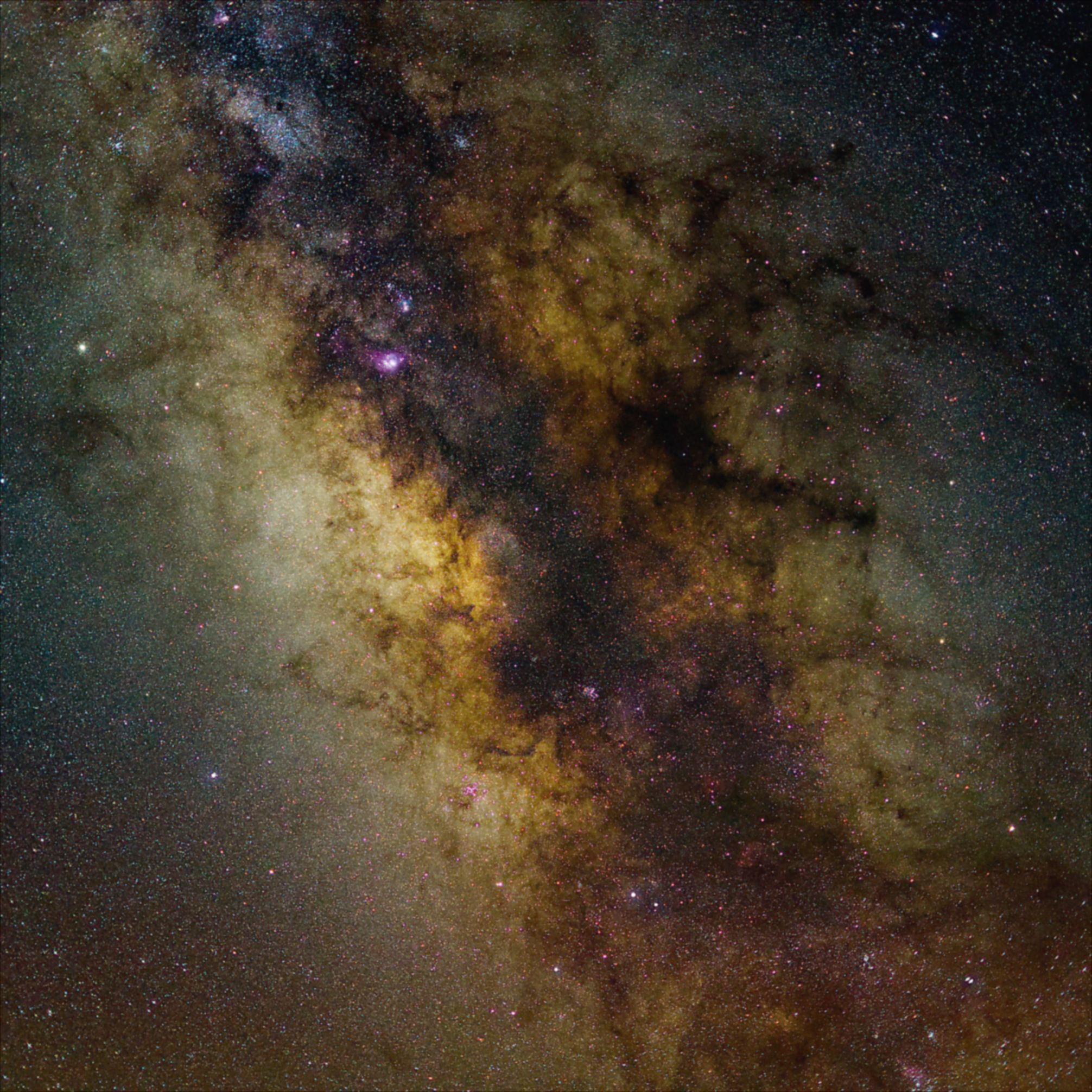
That same evening I also took an image of the summer Milky Way, closely centered on the galactic core.  Same camera, lens, and exposure.


 With the distracting stars blurred, it is much easier to appreciate the immense clouds of dust and gas that obscure our visible-light view of the galactic center.


Wednesday, January 29, 2025

The Head of Orion

 Lambda Orionis, or Meissa, is the brightest star in a sparse open cluster that forms the head of Orion.  The star and its associated cluster, known as CR 69 (Collinder 69), forms a triangle with the two shoulder stars Betelgeuse and Bellatrix.

credit: SkySafariAstronomy.com

Meissa (center).  Tokina 400mm f/5.6 SD + Metabones 0.71x reducer. ISO 1600, 30 s

Seestar S50.  2 min.

Meissa is a visual double star that makes a good target for small telescopes.  The two components are magnitudes 3.4 and 5.5 and are separated by 4.4 arcsec.

Meissa A+B.  Celestron C6 + 2.5x Powermate.  Stack of 3 images, ISO 800,  0.5 s.

Tuesday, January 28, 2025

Capturing an image of the GAIA spacecraft

 The GAIA (Global Astrometric Interferometer for Astrophysics) spacecraft is a European Space Agency (ESA) instrument launched in 2013.  It employs the largest digital camera ever deployed in space (952 MP) and has mapped the positions of over two billion (109) stars with unprecedented precision during its operational life.  Due to dwindling fuel supplies, the science mission was ended on 15 January.  The spacecraft is now undergoing testing and calibrating before it is sent into a graveyard orbit around the sun.

The GAIA spacecraft has resided in an orbit around the L2 Lagrange point, which is a semi-stable location on a line opposite the sun from earth, approximately 1.44 million km (899,000 mi) distant. The spacecraft is normally too faint to be seen from earth except by the largest telescopes.  During this decommissioning phase it has been reoriented with respect to the sun and the brightness is predicted to increase to around magnitude 15.  This is within range of amateur telescopes.

Under the dark sky in Creede I can routinely capture magnitude-15+ asteroids with a 135mm f/2 telephoto lens and 30–60 sec exposures.  That is more difficult with the brighter sky in urban Santa Fe, so this was a good opportunity to test the long-exposure capability of the 250-mm focal length Seestar S50.

GAIA's orbit has recently taken it within a few degrees of the star cluster M67 in the constellation Cancer. This was a good starting point for star hopping to the predicted spacecraft location.  The Seestar app currently has no way to directly enter celestial coordinates, so it was necessary to manually point the scope using the associated SkyAtlas app.

M67, the Golden Eye Cluster.  2 min.

I used a 15-min exposure to capture GAIA.  The centering is off because of the manual positioning and guessing, but it worked:  an image of a spacecraft nearly a million miles away!

GAIA is circled.  cropped from the original image.  11 pm MST 27 Jan.

Here is a finder chart showing the predicted position.  This was generated using the GAIA Ephemeris Service of the ESA.  This shows the expected position in 15-min intervals as seen from Albuquerque, which is the nearest predefined location.  Relative to these positions, there is a parallax of about 0.24 arcmin as seen from Santa Fe.  This finder chart represents just a small section of the above image.


This next image is a chart generated by Stellarium with the predicted position marked by the crossed circle (parallax not accounted for):

Finally, an expanded crop from the Seestar image (about 15 arcmin square) with some stars labeled with the magnitudes pulled from Stellarium.  


Friday, January 24, 2025

Wider views with the Seestar S50

 The IMX462 imaging chip used with the Seestar S50 limits the field of view to 1.27° x 0.71°.  ZWO has included in their Seestar imaging app an automatic mosaic creation tool called "framing" that can double or triple the single-shot field of view.  

I tried the framing mode with two subjects that are a little too wide for a single-shot exposure:  the Double Cluster in Perseus, and the galaxy pair called Bode's Nebulae (M81 and M82) in Ursa Major.   This mode works remarkably well.  The biggest drawback is that it requires considerable time to complete.  The two examples shown here each took 20 minutes before the exposure was ended.  The field-of-view expansion factors were 1.4x and 1.5x.

M82 (left) and M81 (right).  Cropped from the original 1.4x mosaic.

Both of these galaxies were previously captured with the Seestar S50, but are too widely separated to fit into a single frame.  The framing mode nicely captures both at the same time.

The Double Cluster: NGC 869 (bottom) and NGC 884 (top). Cropped from the 1.5x mosaic.

In spite of what I consider to be a long acquisition time, the advantage of the Seestar is that I was seated comfortably in the warm house monitoring the progress on my iPad while these automated exposures ran to completion.

Here is a finder chart showing the location of the two galaxies (Bode's Nebulae) relative to the Big Dipper and Polaris:

credit: SkySafariAstronomy.com


Thursday, January 23, 2025

More comfy indoor observing with the Seestar S50

 Another clear night provided an opportunity to try out the cross-star "filter" with the Seestar S50.  This filter consists of two rigid crossed wires.  It is meant to simulate the diffraction spikes caused by secondary-mirror holders in Newtonian and Cassegrain telescope designs.  It is purely an aesthetic effect.

The Cross-Star filter and lens shade are add-on accessories by Omegon.

NGC 457, the Owl Cluster, in Cassiopeia. 2 min.

Cluster NGC 188 in Cepheus. 8 min.


The open cluster NGC 188 is within the boundary of the constellation Cepheus, but it is only 4 deg from Polaris in the northern sky.  It is a dim cluster that is one of the oldest of its type in our galaxy.

Cluster M52 in Cassiopeia.  5 min.

Galaxy M82, the Cigar Galaxy, in Ursa Major. 5 min.

Bellatrix.  1 min.

Bellatrix is the third brightest star in the constellation Orion.  It is on the right shoulder directly across from red Betelgeuse.