Monday, March 10, 2025

Preparing for the eclipse

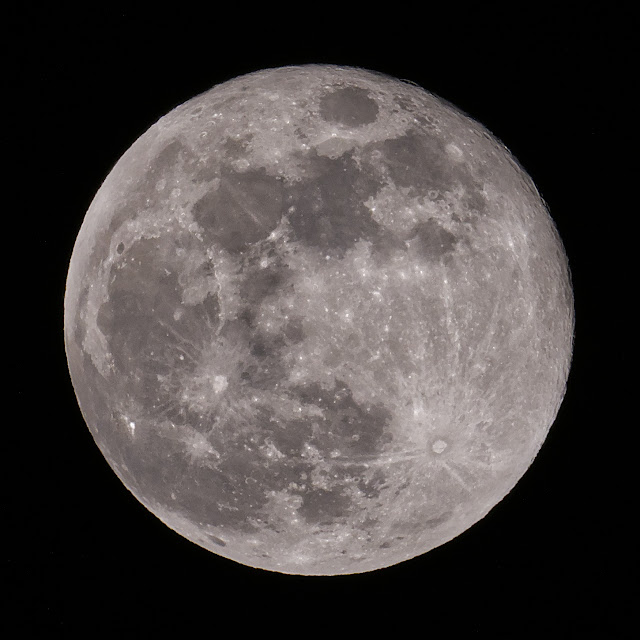
 There will be a total eclipse of the moon on the night of 13-14 March (Thursday pm into Friday am).  It is always good to check equipment ahead of time.  This image was taken with an Orion 80mm ED f/7.5 refractor and an Olympus E-M5iii camera, ISO 200, 1/640 s.

11.9-day moon


Saturday, March 1, 2025

The Night Watch

 I am usually alone with the telescope, but last night I had company.   I heard the scratchy sounds of its arrival, and my headlamp revealed a curious observer.  It sat and watched for about five minutes, but offered no advice or commentary.  This was not the first time it has kept me company under the stars.

Procyon lotor, the star raccoon.

In the constellation Canes Venatici, which lies south of the Big Dipper, there is a deeply-red variable star with the nickname "La Superba".  Its official designation is Y Canum Venaticorum.  At magnitude 5.2, this star is one of the brightest examples of a "carbon star".  These stars have high concentrations of carbon compounds in their atmospheres.  These compounds absorb short-wavelength light and lead to the sunset-like coloration.

La Superba lies south of the handle of the Big  Dipper, between Mizar and Cor Caroli, the two double stars featured in the previous post.

credit: SkySafariAstronomy.com

Capturing this star's color in a wide-angle image is a bit of a challenge.  Diffusion filters definitely help. A darker sky (sqml=19.8 last night) would also help.

Sony A7iii + Rokinon 85mm f/1.4 AFII + Softon filter.  ISO 1600, 30 s.

Olympus E-M1iii + 45mm f/1.8 + Sparkle-6 filter.  ISO 1600, 30 s.

The Hoya Sparkle-6 filter seems to produce the most accurate colors, although the six-pointed star patterns border on looking gimmicky.  The Hoya Softon filter tends to render blue colors better than reds.


Sunday, February 23, 2025

Two easy double stars

 There are two double stars visible in the northeast in the late evening that are easily accessible to small telescopes.  They are Cor Caroli (Alpha Canum Venaticorum) and Mizar (Zeta Ursae Majoris).  Both are easy to find.  Mizar is the brightest component of a naked-eye double star in the handle of the Big Dipper, and Cor Caroli is easily identified by its proximity to the Big Dipper, as seen in the image below. 

Olympus E-M1iii + Olympus 25mm f/1.8.  ISO 800, 30 s. Sparkle-6 filter. sqml=19.8

Cor Caroli consists of two visual components of magnitudes 2.9 and 5.5 separated by 19 arcsec. Mizar is the brightest of the Mizar-Alcor pair that can be seen without a telescope.  With a telescope, Mizar presents as two stars of magnitudes 2.2 and 3.9, separated by 15 arcsec.

In each case, the two visual components are also spectroscopic binaries, meaning that both pairs are actually four-star systems.

Cor Caroli A+B.  Celestron C6 + Olympus E-M5iii. ISO 400, 1 sec.


 The two components of Cor Caroli are also designated α1 and α2, with α1 being the fainter of the pair.  


Mizar A+B.  Celestron C6, ISO 400, 1/3 sec.


 I was able to split both of these doubles using a 50mm f/4 refractor at 20x with some careful concentration.  Both of them were easily split at 40x with no effort.

The telescope in the picture below is a TS-Optics 50mm f/4 ED refractor with a GSO Amici-prism diagonal and a Celestron XCel-LX 5mm eyepiece (approx 40x).  This setup perfectly matches the description of "small telescope".


.

Star Landscape mode with the Canon G9X Mark II

 The Canon G9X-II pocket camera has three astrophotography modes: "Star Portrait", "Star Landscape", and "Star Trails".  In the previous post an example of the "Star Trails" mode was shown.  This post will show results from the "Star Landscape" mode.  This mode has more user-adjustable parameters.  The ISO was set to 800 and the exposure was 15 sec at f/2.  The camera was mounted on a Vixen Polarie star tracker.

Star Landscape: Orion, the Winter Triangle, and Jupiter.

The "Winter Triangle" asterism comprises Sirius (lower left), Procyon (upper left), and Betelgeuse (center).  Jupiter is the bright star at right center edge.  

The G9X offers three options for star processing: Sharp, Off, and Soft.  The above image was obtained using the "Soft" setting.  This mimics the effect of a diffusion filter and is supposed to give a better representation of relative star brightness.


The next three images show the effect of the three settings:

"Sharp" setting

"Off"

"Soft"

There is some astigmatism visible around the edges at f/2, but no worse than many lenses used on interchangable-lens cameras.

Sirius ("Sharp" setting)

 
Sirius ("Soft" setting)


Saturday, February 22, 2025

Star trails with a pocket camera

 The Canon G9X Mark II pocket camera was released in 2017.  My copy was purchased in 2020.  It has several astronomy-related scene modes which I have never utilized, until now.  The three modes are "Star Portrait", "Star Nightscape", and "Star Trails".  The latter mode is very similar to the "Live Composite" shooting mode offered by some Olympus (now OM-System) cameras.  

The Canon "Star Trails" mode does not offer much in terms of user-adjustable settings.  The exposure time from 10 minutes to 2 hr (in 10-min increments) and AF/MF are about the only choices.  For this test I set up the camera on a tripod pointing north, chose "60 min" for the exposure, pressed the shutter button, and walked away.


Thursday, February 20, 2025

Crescent Venus

 At magnitude -4.6, Venus is the brightest object in the sky after the Sun and the Moon.  It is currently in its crescent phase, 22% illuminated.  The crescent phase is easlly observed with a small telescope.

These images were obtained during twilight at 6 pm on 20 Feb  while the planet was 32° above the horizon. The equipment used was a Celestron C6 SCT and an Olympus E-M5iii camera.  Exposure was 1/1600 sec at ISO 400. 

The best single image.

A stack of the three best images.

six-image animation.

This six-image animation shows the effect of atmospheric turbulence.  Dedicated planetary-photography practitioners will typically record a video consisting of hundreds (or more) frames, then select the sharpest fraction of that total to stack into a final image, with results that can be spectacular.  I am not a dedicated practitioner.

Thursday, February 13, 2025

How far away is the Moon?

 Yesterday (12 Feb) was the February full moon, traditionally known as the "Snow Moon".  The clear sky provided an opportunity for a fun experiment: measure the distance to the moon.

The idea is simple.  Take a picture of the rising moon, and with the same equipment take another picture near midnight.  The moon will appear bigger at midnight because we are then closer by some fraction (depends on latitude) of the earth's radius.  If you know the radius of the earth, then the ratio of the two moon sizes and some simple math gives the distance to the moon.  The size of the earth was first measured in 240 BC by Eratosthenes, to an accuracy better than 1%.

The equipment used was an Astro-Tech AT72EDII f/6 refractor and field flattener with an Olympus E-M5iii camera.

The Snow Moon rising over the Sangre de Cristo mountain ridgeline.

It's hard to avoid utility lines when you live in the city.

Color balance adjusted to remove atmospheric color.

Approaching midnight (11:15 pm)

The moon near midnight was about 8 ± 1 pixels wider (1.4%) than the moon as it rose above the distant hills.  Taking into account the latitude of Santa Fe (35.7 deg) only, and ignoring the declination of the moon (12.3 deg),  the derived geocentric distance is L = 234,900 mi (378,00 km).   The ephemeris distance extracted from SkySafari was 242,028 mi (389,508 km).  This simple measurement therefore agrees with the known distance to within 3% (but with 13% uncertainty).

This technique could be improved by using a longer focal length scope to increase the pixel difference between the rising and transiting images.  Stacking images of the moon would also average out the blurring caused by atmospheric turbulence, particularly near the horizon.  But that's a lot more work, so yeah, I'm not going to do that.